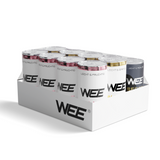
A Look at the Region, Winegrowing Culture, and its Influence on WEE WINE
The Palatinate is more than a wine region. It is a developed cultural area where climate, soil, and tradition have interacted for centuries. Those who produce wine here work not only with vines but with history, experience, and a strong regional identity. This very origin also shapes WEE WINE – and is palpable in every sip.
WEE WINE understands the Palatinate not as a marketing term, but as a foundation. The region provides the basis for structure, freshness, and character – transforming a modern product into an authentic piece of origin.
A Region with Ideal Conditions
The Palatinate is one of Germany's most important winegrowing regions. Its special climate is characterized by many hours of sunshine, mild temperatures, and the protection of the Palatinate Forest.
These conditions create ideal prerequisites for fruit-driven, clear, and vibrant wines. At the same time, the diverse soils – from limestone to loess to sandstone – ensure different expressions in the wine.
The result is a region that not only enables diversity but systematically produces it.
Winegrowing as a Craft Across Generations
In the Palatinate, winegrowing is not a short-term project, but a living tradition. Many businesses have worked in family or cooperative structures for generations. Knowledge is passed on, refined, and continuously developed.
The collaboration with the Winzergenossenschaft Kallstadt eG and ZAMME also exemplifies this principle: over 120 years of concentrated experience meet modern precision and new product ideas.
This creates not a break between tradition and innovation, but a fluid transition.
Origin as a Promise of Quality
For WEE WINE, origin is not a label, but a promise of quality. The Palatinate stands for clear wines with recognizable structure, precise fruit, and natural freshness.
These characteristics form the basis for the modern composition of WEE WINE. The wines bring depth and character, while further processing translates them into a lighter, contemporary form.
Thus, origin does not remain abstract, but becomes tasteably tangible.
From the Vineyard to the Moment
The path from the Palatinate to the glass is deliberately kept short at WEE WINE – not geographically, but conceptually. The idea is to transport origin directly into the moment, without detours or overlay.
The combination of selected Palatinate wines, modern composition, and finely tuned balance ensures that the character of the region is preserved, but reinterpreted.
This creates a product that not only comes from the Palatinate but carries the Palatinate within it.
The Role of Nature in Taste
The influence of the region is particularly evident in the taste. The fruit appears clear and juicy, the acidity lively, the structure precise. These characteristics are no coincidence, but the result of climate, soil, and winegrowing culture.
The Palatinate produces wines that are ideally suited for modern interpretations: accessible yet characterful; fresh yet structured.
WEE WINE as a Modern Translation of Origin
WEE WINE takes this regional identity and translates it into a contemporary format. The classic wine structure is retained but is brought into a new form through the composition with water and carbonation.
This creates a product that does not change origin but makes it more accessible.
The Palatinate always remains the origin – visible, tasteable, and palpable.
Conclusion: Origin That Endures
The Palatinate is not a background for WEE WINE, but its core. It provides the foundation for quality, character, and authenticity.
In a time when products are often viewed disconnected from their origin, WEE WINE deliberately focuses on connection. Between region and consumption. Between tradition and modernity. Between vineyard and moment.
Because true origin does not disappear in the glass.
It only becomes truly visible there.